FUE vs. FUT: Which Hair Transplant Method Is Right for You?
A side-by-side comparison of follicular unit extraction (FUE) and follicular unit transplantation (FUT) hair transplant methods, covering scarring, recovery, cost, and graft yield.
Two Approaches, One Goal
If you're considering a hair transplant, the first decision you'll face is choosing between FUE (follicular unit extraction) and FUT (follicular unit transplantation, also called strip surgery). Both methods permanently relocate hair from your donor area to where you need it. The difference is in how grafts are harvested.
How FUE Works
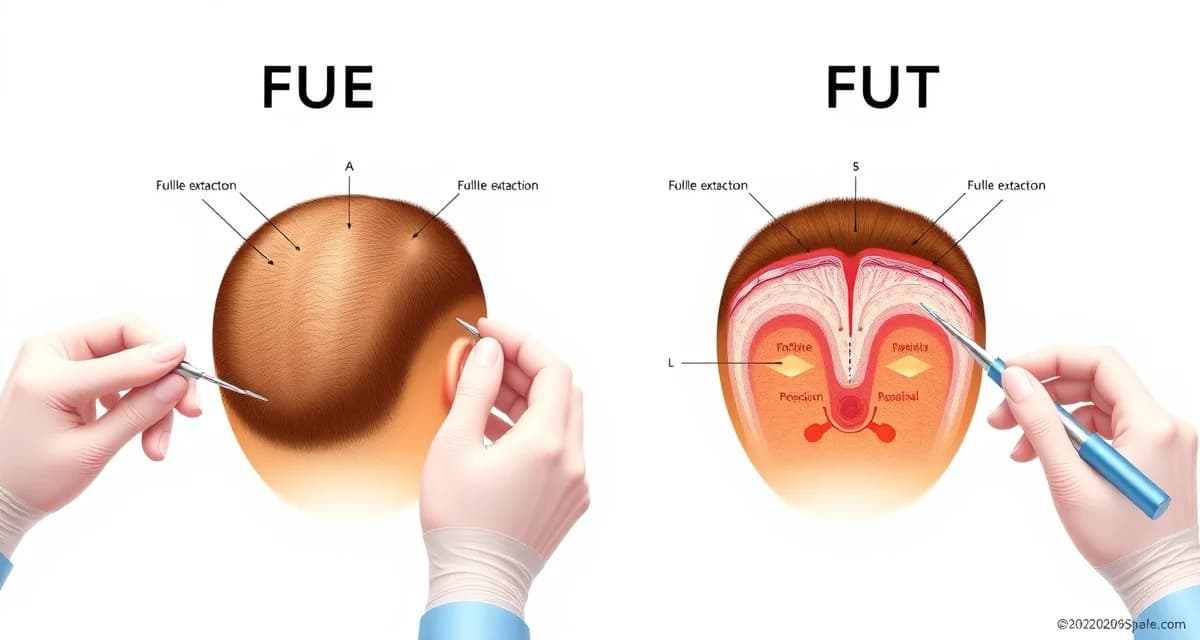
In FUE, the surgeon uses a small circular punch (typically 0.7mm to 1.0mm) to extract individual follicular units directly from the donor area. Each graft is removed one at a time through a tiny incision that heals as a nearly invisible dot. Modern FUE can be performed manually, with motorized punches, or with robotic systems like the ARTAS iX.
The main advantages: no linear scar, shorter recovery, and the ability to wear your hair very short. The trade-offs: FUE typically takes longer per graft, costs more, and may have slightly lower graft survival rates in less experienced hands because each graft is handled individually.
How FUT Works
In FUT, the surgeon removes a narrow strip of skin from the back of the scalp, then closes the wound with sutures or staples. Skilled technicians dissect the strip under microscopes to separate individual follicular units. This method can yield a large number of grafts in a single session.
FUT's strength is efficiency: it generally delivers more grafts per session, has high graft survival rates (because follicles stay protected in the strip until dissection), and costs less per graft. The downside is a linear scar along the back of the head, which is visible if you wear your hair very short.
Scarring Comparison
FUE leaves tiny circular scars scattered across the donor area. They're generally undetectable at hair lengths above a #2 guard. FUT leaves a single linear scar that can range from pencil-thin to several millimeters wide, depending on the surgeon's skill and your skin elasticity. Many surgeons now use trichophytic closure to allow hair to grow through the scar line.
Recovery Timeline
FUE patients typically return to desk work within 3-5 days. The tiny extraction sites scab over and heal within 7-10 days. FUT patients may need 10-14 days before feeling comfortable at work, and sutures or staples are removed at 10-14 days. Both methods share similar timelines for the recipient area: redness fades over 2-4 weeks, transplanted hairs shed at 2-4 weeks, and new growth begins at 3-4 months.
Cost Differences
FUE generally runs $5 to $10 per graft in North America, while FUT ranges from $4 to $8 per graft. For a 2,000-graft case, that might mean $10,000-$20,000 for FUE versus $8,000-$16,000 for FUT. International pricing (especially Turkey, India, and Thailand) can be significantly lower, but research clinic credentials carefully.
Which Should You Choose?
Consider FUE if you want to wear your hair short, prefer a faster recovery, or need grafts from body donor areas. Consider FUT if you need a large number of grafts in one session, want the most grafts per dollar, or plan to keep your hair at a length that covers the donor scar. Some patients opt for a combined approach, using FUT for maximum yield and FUE to harvest additional grafts or camouflage the strip scar. Consult with at least two IAHRS-certified surgeons before deciding.